
Revesby Wood is a bit special. As well as being a valuable extension of the Wandle green corridor from Poulter Park to Middleton Open Space, it’s also been a continued woodland space on maps since at least 1620.
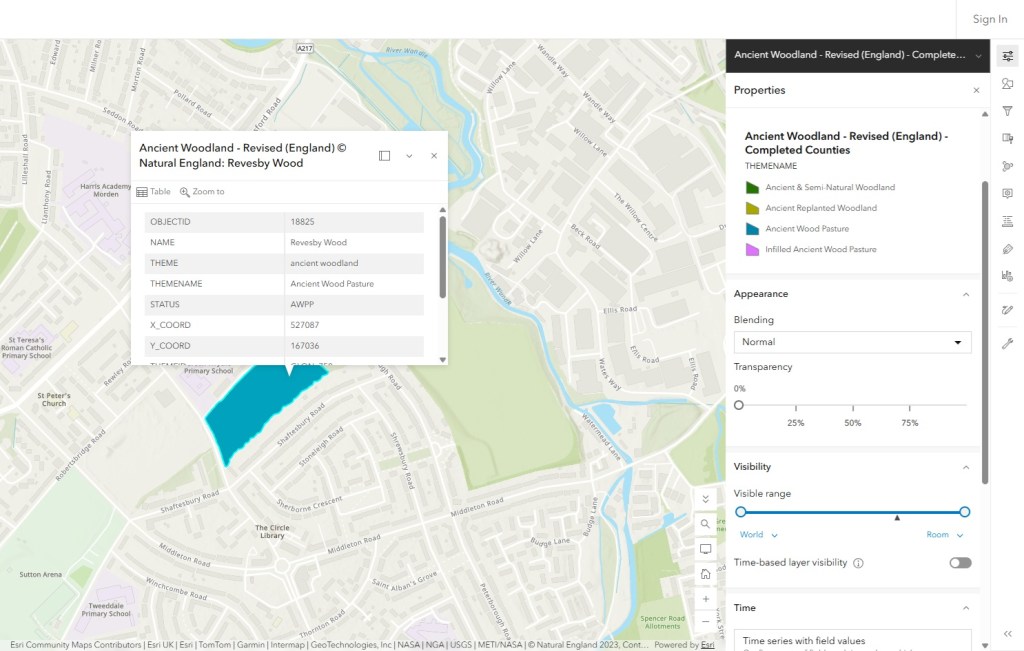
This means it is classed as Ancient Woodland Pasture, although it’s been cut back and replanted over time.
Ancient woodland
Revesby Wood first appears as woodland on a map made over 400 years ago, in around 1620 and seems to have remained as woodland ever since. It shows up on John Rocque’s map of Surrey in about 1760. Then again in the Mitcham Grove House estate sale of 1828, an 1848 tithe map, and subsequent Ordnance Survey maps.
In the early 1800s Henry Hoare, the then owner of Mitcham Grove House and Revesby Wood, wrote to his friend Rev Shuttleworth as he was worried that his tenant Mrs Batts was taking liberties with his timber. He was vexed as she had come onto the land and marked trees for felling without consulting him. We don’t know what happened as a result but it’s good to know Revesby’s owner was serious about woodland management!
In 1828 the wood was sold as part of the land attached to Batt’s farm (opens on St Helier Memories website) which was part of the Mitcham Grove estate. Later that year various timber trees on the farm were offered for sale, including 123 oaks which were probably from the wood.
What sort of trees are in Revesby Wood today?
Clearance and replanting with young trees in the 1990s gave us the Revesby Wood we know today.
Lots of blackthorn, hawthorn, hazel and cherry plum which put on beautiful pink and white blossom displays every spring. These younger trees are interspersed with birch, ash and maple trees. There’s also a hornbeam hiding in the undergrowth and some spindle, which is an ancient woodland indicator.
Above the younger trees is a protective canopy of oaks, some of these older trees could be a hundred years old or more.
Who lives in Revesby Wood?
The scrub and mature trees are home to lots of birds, like our ubiquitous green ring-necked parakeets. But we also hear song thrushes, robins, chiffchaffs, woodpeckers, gold finches, goldcrests, jays, wrens, black caps and house sparrows.
House sparrows and song thrushes are particularly in decline so it’s lovely to hear them in the trees. High overhead we often see sparrow hawks, kestrels and the occasional bigger bird of prey circling. And at night we hear the tawny owl make its rounds.
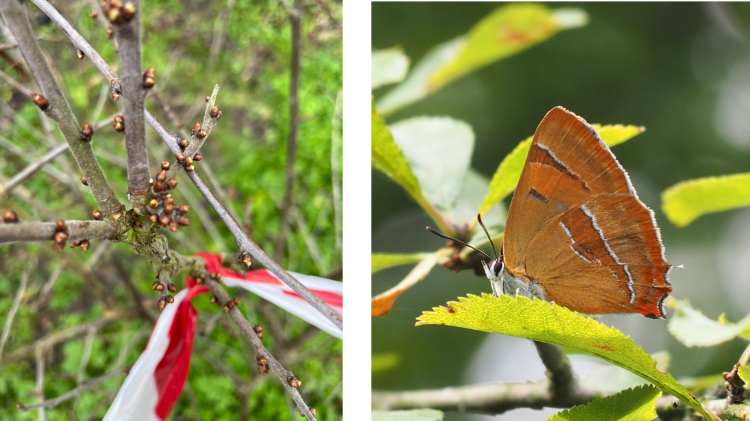
You can spot many beautiful butterflies in Revesby Wood. But it’s most notably home to the rare Brown Hairstreak butterflies, who lay their eggs in the Blackthorn bushes.
We also see hedgehogs snuffling through the undergrowth. Our local safer neighborhood police team made this poster for us after a sighting last year!

The fight against fly tipping
Sadly over the years, it became a dumping ground for fly tippers. We’ve spent a lot of time removing commercial and household waste so we can start managing the space as a woodland. But we need your help.
You can get involved by reporting fly tips to the council and joining us on a litter pick.
References
- The information in this blog was mainly taken from the Management Plan for St Helier Open Space, Middleton Open Space, Revesby Wood, Poulter Park. Historical research in the report is by John Phillips.
- We also used our own bird sightings and recordings and learnt lots from the fab St Helier Memories website.
If you have any memories or knowledge about Revesby Wood, or Poulter Park we’d love to hear from you!


One thought on “History of Revesby Wood”